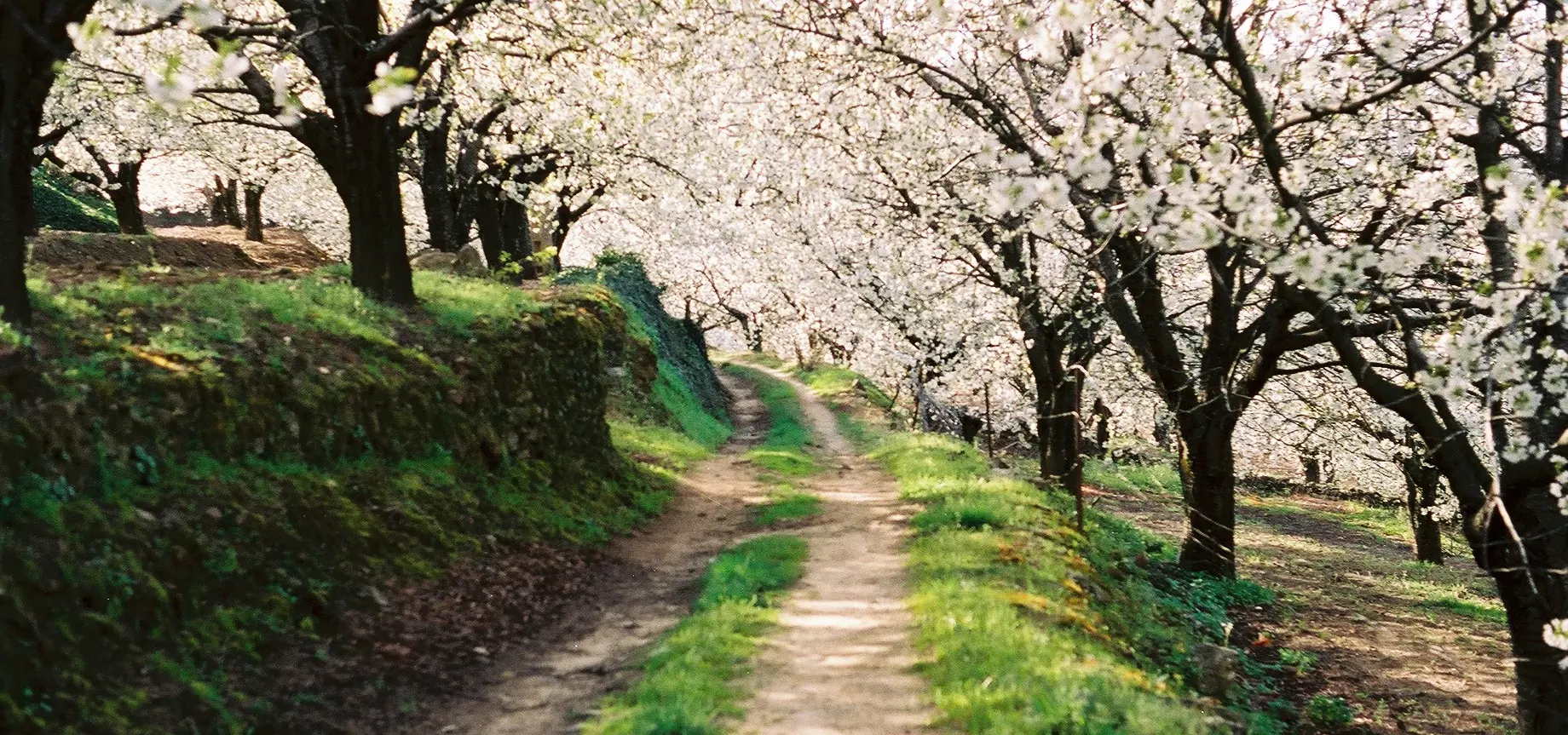
Jerte Valley and La Vera: Cherry Blossoms and Yuste Monastery
Best Season
Ideal spring (cherry blossom). Hot summer in the valley floor. Tornavacas pass snowy in winter.
The Jerte Valley with two million cherry trees blooming in spring, the villages of La Vera with their half-timbered architecture, and Yuste Monastery where Charles V spent his final days. Intimate Extremadura.
Highlights
- 1Two million cherry trees in blossom (March-April)
- 2Monastery of Yuste: Charles V's retreat
- 3The villages of La Vera: half-timbered architecture
- 4Puerto de Tornavacas: 40 km of climbing through cherry orchards
About this route
The Jerte Valley is one of the most striking natural spectacles in all of Spain and, paradoxically, one of the least known outside Extremadura. Every spring, between late March and mid-April, more than two million cherry trees blossom simultaneously across the valley's slopes, turning the mountains a dazzling white that, seen from the viewpoints along the N-110, looks like snow out of season. It is spectacular enough to draw tens of thousands of visitors during the two weeks the blossom lasts — but outside that window the valley empties out, and the roads winding between the cherry orchards are a rider's paradise of light traffic and constant bends.
The road climbing from Plasencia to the Puerto de Tornavacas (1,274 m) on the EX-203 is one of the finest in Extremadura: over 40 km of gradual ascent along the valley floor, with turnoffs to villages terraced into the slopes — Cabezuela del Valle, Jerte, Navaconcejo, Tornavacas — each with its square, its fountain, its stone-and-timber houses and its cherry trees. The Puerto de Tornavacas, on the border with Ávila, opens up views over the whole valley and is the route's turning point: from here you drop towards La Vera down the southern flank of the Sierra de Gredos.
La Vera is a district running parallel to the Jerte but with an entirely different character. Where the Jerte is a narrow, humid valley dominated by cherry trees, La Vera is a succession of gargantas — mountain torrents dropping off Gredos into natural pools — and villages built in half-timbered architecture of wood, adobe and stone, several of them World Heritage sites. Cuacos de Yuste, Villanueva de la Vera, Valverde de la Vera and Garganta la Olla preserve arcaded squares and medieval streets of an authenticity that is hard to believe.
The Monastery of Yuste, hidden among oak woods just outside Cuacos, is where Charles V — the most powerful ruler in the 16th-century world, king of Spain, Holy Roman Emperor, lord of half the Americas — chose to retire in 1556 to spend his final years in solitude and prayer. It is an austere Hieronymite monastery with an attached palace that includes a ramp so the emperor, crippled by gout, could be carried by litter directly from his bedchamber to the church. The visit is deeply evocative.
Practical notes: the best time is the cherry blossom (late March to mid-April), but the roads are excellent all year except in deep winter. The Puerto de Tornavacas can hold snow from December to February. For food, in Jerte the roast kid and the cherries (fresh in June, in aguardiente all year) are the star products. The Picota del Jerte — a stemless cherry with protected designation of origin — is the best cherry in Spain. Fuel in Plasencia.
Route stops
Cabezuela del Valle
Village
Medieval Jewish village among cherry trees, with Jewish quarter.
Monasterio de Yuste
Monument
Emperor Charles V's retirement, 15th-century Hieronymite monastery.
Garganta la Olla
Village
Half-timbered village with the House of Dolls.
Practical information
Weather
Ideal spring (cherry blossom). Hot summer in the valley floor. Tornavacas pass snowy in winter.
Traffic
High traffic during blossom season (2 weeks). Low the rest of the year.
Fuel stops
Petrol stations in Plasencia and Jaraíz de la Vera. Scarce in the valley.
Where to stay on this route
The towns this route passes through — useful for splitting it into stages or sleeping near the start. Book ahead in high season.
- Cabezuela del ValleSee places to stay
- Monasterio de YusteSee places to stay
- Garganta la OllaSee places to stay
Affiliate links: if you book through them, Nomadiq earns a small commission at no extra cost to you.
Related routes
Las Hurdes and Sierra de Gata: Spain's Most Remote Corner
Extremadura
Monfragüe, Trujillo and Cáceres: Vultures, Conquistadors and UNESCO
Extremadura
Sierra de Francia and La Alberca
Castile and Leon
Arribes del Duero
Castile and Leon