Sierra de Francia and La Alberca
Best Season
Cold winters, possible snow at altitude. Better in spring and autumn.
The Sierra de Francia in Salamanca with La Alberca, the first village to be declared a Historic Site in Spain, and the ascent to the Pico de la Peña de Francia with views over three provinces.
Highlights
- 1La Alberca: Spain’s first village to be designated a Historic Site
- 2Mogarraz: the village of portraits
- 3Peña de Francia Peak (1,723 m)
- 4Authentic mountain villages
About this route
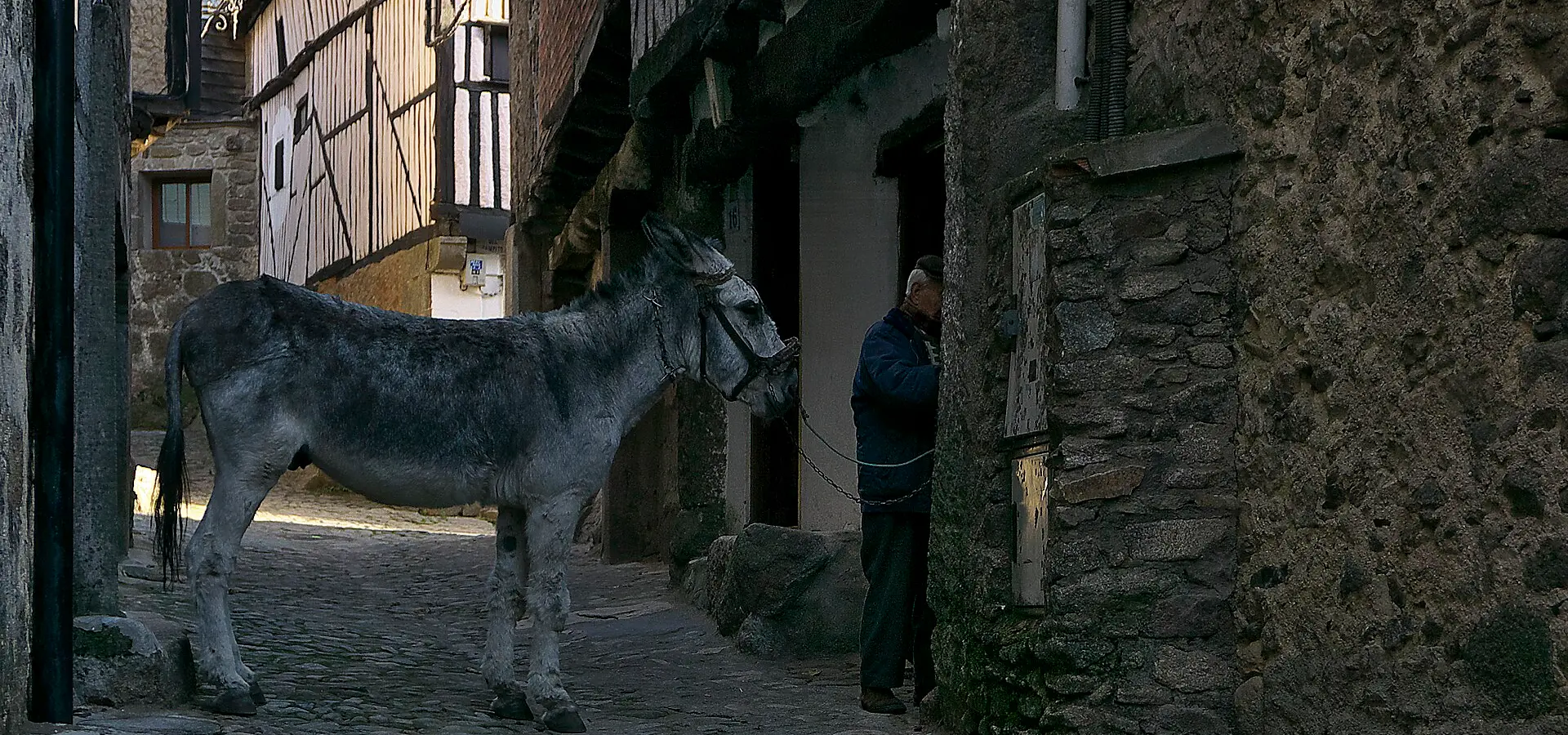
La Alberca holds a historic record that few villages can claim: in 1940, it was the first municipality in the whole of Spain to be officially declared a ‘National Historic-Artistic Site’, a distinction that recognised the extraordinary state of preservation of its traditional mountain architecture. And even today, almost 90 years later, La Alberca remains probably the most complete and authentic example of a village in the Sierra de Francia: houses with exposed wooden beams, cantilevered balconies, carved lintels, arcaded squares and, above all, a virtually intact medieval town layout. Strolling through its streets is like stepping into a perfectly calibrated time machine.
The interesting thing about La Alberca is that it has kept its folk traditions alive, whereas in other places they disappeared centuries ago. Even today, during the festivities for the Assumption on 15 August, the women of the village take part in the procession dressed in the traditional mountain costume — one of the most intricate and expensive folk costumes in the whole of Spain, featuring heirloom jewellery, embroidered skirts and Manila shawls — whilst the men play traditional music on stringed instruments. It is one of the few places in Castile and León where folk culture is not a tourist attraction but a genuine continuation of the past.
The Sierra de Francia, where La Alberca is situated, is one of the lesser-known mountain ranges of the Central System, a granitic massif with peaks exceeding 1,700 m, covered in dense forests of Pyrenean oak and chestnut. Its most famous peak is the Peña de Francia (1,727 m), home to a sanctuary dedicated to the Virgin of the Peña de Francia, which is one of the most important places of pilgrimage in western Castile and León. The road leading up to the sanctuary is a real gem for motorcyclists: 12 km of continuous bends on excellent tarmac, with no traffic apart from on public holidays, and panoramic views every time the forest opens up.
Mogarraz, just 4 km from La Alberca, is well worth a visit in its own right thanks to a story that is unique in Spain: in the 1970s, the local painter Florencio Maíllo decided to paint oil portraits of all the village’s inhabitants (388 people at the time) and hang each portrait on the façade of every resident’s house. Today, Mogarraz has almost 400 portraits hanging on its walls, forming a truly unique open-air museum that has turned the village into one of the most photographed spots in the mountains. The story behind the project — Maíllo wanted to preserve the village’s visual memory before depopulation erased it — lends a special emotional dimension to the visit.
Motorcycling tips: The Sierra de Francia has a long motorcycling season (from March to November), but the best time to visit is during the weeks in October when the chestnut and oak trees turn golden. Fill up with petrol in Béjar or Salamanca before heading into the mountains. For a bite to eat in La Alberca, avoid the restaurants in the Plaza Mayor (expensive and touristy) and head up to Mesón Casa Teresa, tucked away in a narrow lane in the old town, where they serve calderillo serrano (a traditional stew with potatoes, chickpeas, chorizo and black pudding) at reasonable prices. One final tip: spend at least an hour wandering through the streets of La Alberca at sunset, when the golden light falls obliquely on the wooden beams and the whole village looks like a set from a Renaissance film.
Route stops
La Alberca
Monument
First village in Spain to be declared a Historic Site.
Mogarraz
Village
Mountain village with painted portraits.
Peña de Francia
Viewpoint
Peak at 1,723 m with a sanctuary.
Practical information
Weather
Cold winters, possible snow at altitude. Better in spring and autumn.
Traffic
Very low traffic. Lonely roads.
Fuel stops
Petrol stations in Salamanca and Béjar.
Where to stay on this route
The towns this route passes through — useful for splitting it into stages or sleeping near the start. Book ahead in high season.
- La AlbercaSee places to stay
- MogarrazSee places to stay
- SalamancaSee places to stay
Affiliate links: if you book through them, Nomadiq earns a small commission at no extra cost to you.
Related routes
Arribes del Duero
Castile and Leon
Sierra de Gredos: La Plataforma and Pedro Bernardo
Castile and Leon
Las Hurdes and Sierra de Gata: Spain's Most Remote Corner
Extremadura
Jerte Valley and La Vera: Cherry Blossoms and Yuste Monastery
Extremadura