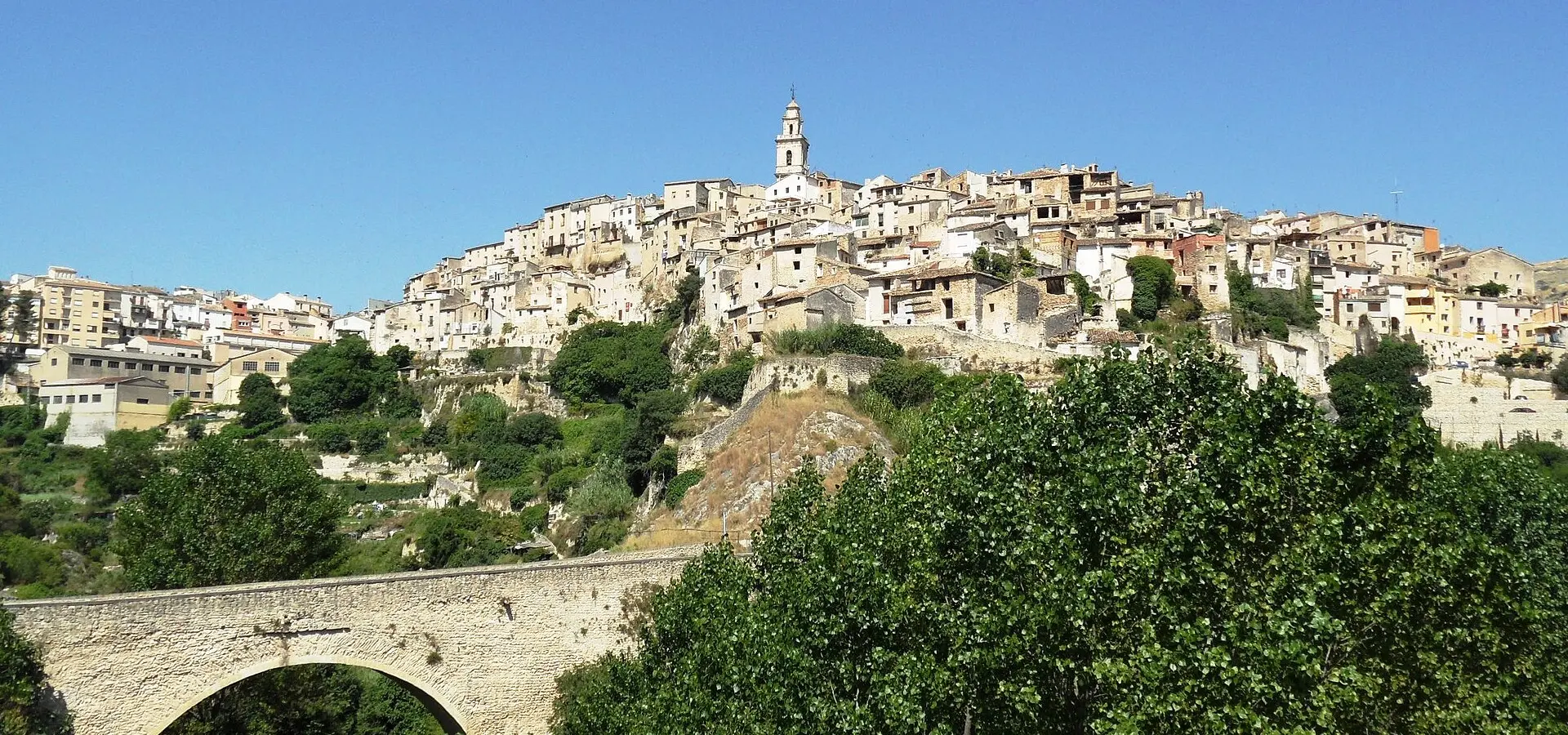
Xàtiva, Bocairent and Banyeres de Mariola
Best Season
A good route nearly all year round. Hot summers but bearable.
Three medieval towns linked by quiet roads: Xàtiva with its double castle, Bocairent with its caves and Banyeres de Mariola, in the heart of the natural park.
Highlights
- 1Xàtiva Castle: panoramic views of the Júcar
- 2Bocairent and its medieval caves
- 3Banyeres de Mariola and its Templar castle
- 4Sierra de Mariola Natural Park
About this route
Xàtiva has an extraordinary political and cultural history that few visitors are fully aware of: it is the birthplace of two popes from the Borja family (Calixto III, Pope from 1455 to 1458, and the famous Alexander VI, Pope from 1492 to 1503), one of the most powerful, wealthy and controversial dynasties of the European Renaissance. The Borgias were originally from Xàtiva and from here they extended a network of power that reached right into the heart of the Vatican, where they amassed influence, wealth and enemies in extraordinary quantities. The church in Xàtiva preserves the memory of the dynasty, and the historic centre is dotted with palaces belonging to the Borjas and their associated families. Cervantes passed through Xàtiva on his travels and mentioned it several times in his works.
Xàtiva Castle is probably one of the most spectacular and geographically unusual castles in the whole of Spain. It is not one castle, but two: the ‘Castell Major’ and the ‘Castell Menor’, both situated atop the same hill but separated by several hundred metres by a deep ravine. This duality (unique in Europe) stems from the site’s complex history: the Castell Menor is of Iberian-Roman origin, the Castell Major is a Muslim fortress dating from the 8th to the 12th centuries, and the two were united for defensive purposes in the 14th century. Today, you can visit the entire complex (on foot or by motorbike to the car park), and the views from the top take in the whole of the Valencian coast, the Mariola mountains to the south and the Xàtiva farmland to the north. It is one of the most comprehensive viewpoints in central Valencia.
Bocairent, the next stop on the route, is home to another curiosity that is unique in the whole of Spain: the ‘Covetes dels Moros’, a series of man-made caves carved vertically into a rock face at the foot of the village, comprising more than 50 cavities spread across five superimposed levels, accessible only via narrow staircases carved directly into the rock itself. The original purpose of these caves (dating from the 10th–12th centuries, the Al-Andalus period) is a subject of academic debate: a communal granary? A defensive refuge? Funerary columbariums? Today, they are simply one of the most mysterious archaeological sites in the east of the Iberian Peninsula and can be partially visited on a guided tour.
The historic centre of Bocairent itself is probably the best-preserved medieval town centre in the whole of the province of Valencia. Its streets are so narrow that in some places two people cannot pass each other, the houses are white with carved lintels, and the layout of the buildings creates an utterly charming labyrinth. The Plaça de l’Ajuntament, with its three-storey 16th-century Renaissance town hall and the Gothic parish church next to it, is one of the most photogenic squares in the Valencian interior. Bocairent was declared a Historic-Artistic Site in 1986.
A motorcycling outing: the route is a leisurely one (just 125 km, with no major mountain passes, good tarmac and quiet country roads) and ideal for a weekend trip. The route is suitable practically all year round, although it can get hot at midday in summer. Fill up with petrol in Xàtiva at the start. For lunch, in Bocairent, Mesón La Plaza serves traditional Valencian inland cuisine made with local produce at reasonable prices. And a tip: if you have an extra hour, take the detour to Pou Clar (8 km south of Bocairent), a series of natural pools on the River Vinalopó with turquoise waters and waterfalls formed by limestone erosion. In summer, they’re a popular spot for swimming; in winter, they make a perfect waterside viewpoint for taking photos.
Route stops
Castillo de Xàtiva
Monument
Double castle with views over La Costera.
Bocairent
Village
Medieval village with caves carved into the rock.
Banyeres de Mariola
Village
Village with a Templar castle in the heart of the mountains.
Practical information
Weather
A good route nearly all year round. Hot summers but bearable.
Traffic
Moderate traffic, heavier at weekends.
Fuel stops
Fuel stations plentiful in Xàtiva, Ontinyent and Banyeres.
Where to stay on this route
The towns this route passes through — useful for splitting it into stages or sleeping near the start. Book ahead in high season.
- Castillo de XàtivaSee places to stay
- BocairentSee places to stay
- Banyeres de MariolaSee places to stay
Affiliate links: if you book through them, Nomadiq earns a small commission at no extra cost to you.
Related routes
Caroig Massif: Bicorp and Quesa
Valencian Community
Tous Reservoir and the Inland Júcar Ribera
Valencian Community
Alcoy, Carrasqueta and Xixona
Valencian Community
Vall d'Ebo, Vall d'Alcalà and Castell de Castells
Valencian Community