Vall de Gallinera - Moorish Villages
Best Season
Spring (March-May) ideal for cherry blossom. Autumn excellent with warm colours. Summer hot but bearable indoors. Winter may be frosty in shaded areas.
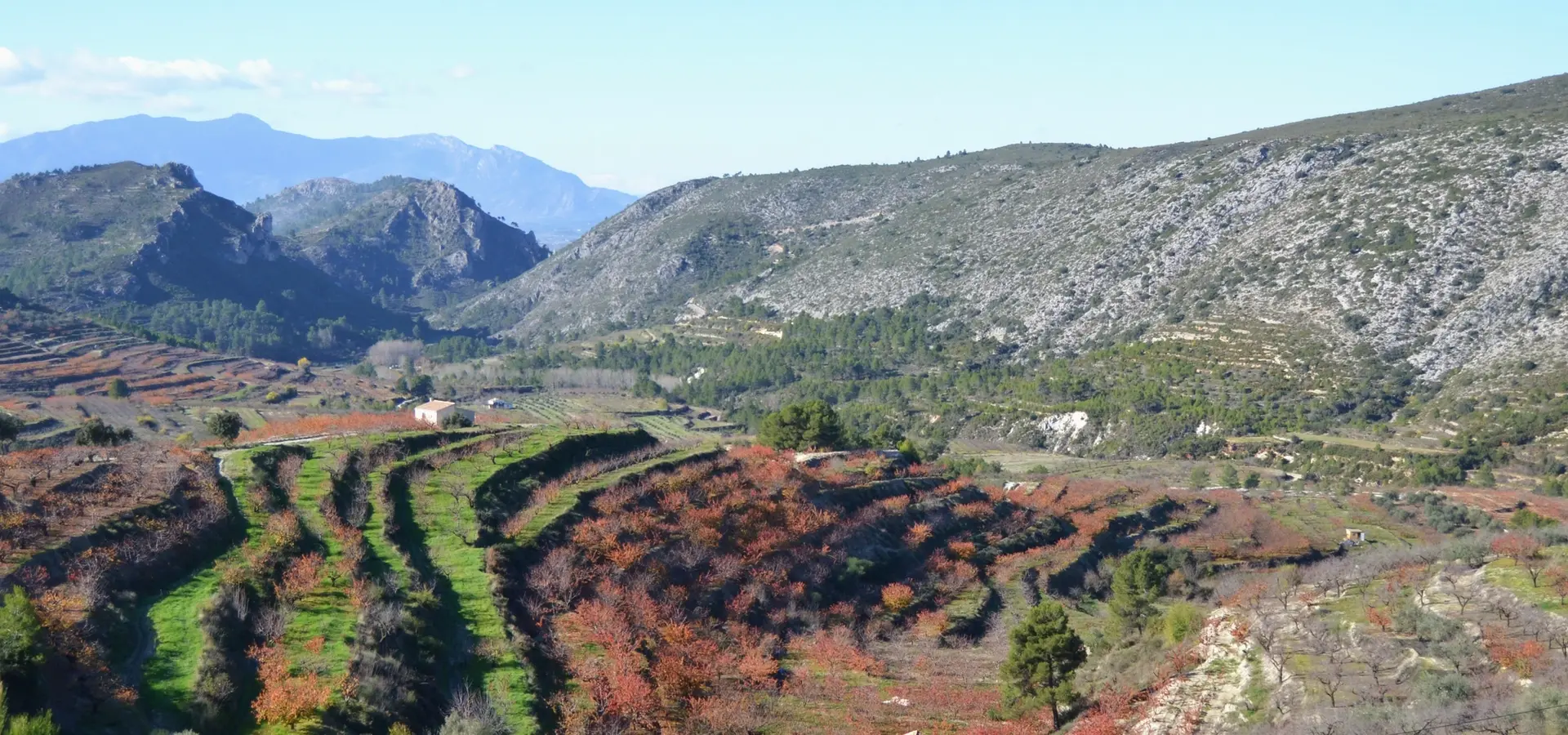
A tour through the 8 Moorish villages of the Vall de Gallinera, one of the best kept secrets of the Marina Alta. Narrow roads between cherry and almond trees and traditional architecture that seems to be frozen in time.
Highlights
- 1The eight Moorish villages of the Vall de Gallinera, with their traditional architecture still intact
- 2Cherry blossom in March–April: a unique natural spectacle
- 3CV-712: a narrow, winding road with little traffic
- 4Benissili: the main village, with bars serving tapas made with local produce
- 5Option to extend the route via Vall d'Ebo for more bends
- 6Cocentaina: a historic town with a castle and an old town
- 7Mediterranean mountain landscapes with almond, olive and pine trees
About this route
The Vall de Gallinera is one of the most authentic yet least well-known corners of the entire province of Alicante. It is a long, narrow river valley (barely 15 km long) nestled between the Carrascal de Alfaro and Foradà mountain ranges, with a succession of eight small villages —Benirrama, Benialí, Benissivà, Benitaia, La Carroja, Alpatró, Llombai and Benissili— all of Moorish origin and all perfectly preserved. These villages share a name that reveals their past: the prefix ‘beni’ (Arabic for ‘sons of’) indicates that each was originally an Al-Andalus farmstead associated with a specific family lineage. It is one of the few places in Spain where the Arab influence on place names and town planning is so visible and so comprehensive.
The tragic history of the Vall de Gallinera is one of the best-documented accounts of the entire expulsion of the Moriscos in 1609. When Philip III ordered the definitive expulsion of the Morisco population from the Kingdom of Valencia, the inhabitants of the Vall de Gallinera put up military resistance, taking refuge in a fortress atop the Penyó de Bèrnia, where they held out for weeks until they were finally defeated by the troops of the Marquis of Caracena. More than 5,000 Moriscos were shipped from the port of Dénia to Algeria, leaving the villages completely deserted. The subsequent repopulation with Mallorcan families (the new Christian settlers came almost entirely from Mallorca, brought over by the Duke of Gandia, who was lord of the valley) brought with it the Mallorcan dialect, customs and architecture, traces of which can still be seen in the valley’s local culture today.
The most spectacular and distinctive feature of the Vall de Gallinera is its famous cherry blossom season, considered one of the three best in the whole of Spain (alongside the Jerte Valley in Cáceres and El Bierzo in León). The valley’s cherry trees — more than 100,000 trees still grown on traditional terraces inherited from the Moorish period — blossom between the last week of February and the first week of April, depending on altitude and temperature, creating a landscape that is literally white, stretching the entire length of the valley. During these weeks, people from the surrounding area flock to the Vall de Gallinera, and the villages celebrate ‘Cherry Blossom Days’ with guided tours, street markets and tastings of local produce.
La Foradà, a natural geological formation atop the mountain range of the same name which closes off the valley to the west, deserves a paragraph of its own. It is a natural limestone arch that has been carved out over millions of years by water and wind, forming a perfectly circular ‘window’ some 6 metres in diameter at an altitude of 800 metres. Every year, around 12 October, a very unusual natural phenomenon occurs: the setting sun, at the exact moment of the autumnal equinox, passes through the Foradà in perfect alignment, illuminating a precise spot at the bottom of the valley for a few minutes. This solar alignment is the subject of local legends and attracts photographers from all over Spain every year.
Motorcycling tips: The Vall de Gallinera has just one road (the CV-700) which runs the length of the valley from north to south; it is narrow but perfectly tarmacked, with continuous but gentle bends. The best times to visit are during the cherry blossom season (February–March) and in autumn (when the fruit trees turn red). It gets very hot in summer. Fill up with petrol in Pego before heading up: there are no petrol stations inside the valley. For a meal, in Alpatró, Restaurant Llinares serves traditional Valencian cuisine using produce from the valley (cherries prepared in a thousand different ways, including an exceptional homemade liqueur). And a tip: if you’re visiting at the height of the blossom season, set off on your motorbike at dawn. The golden light on the white cherry trees is absolutely magical.
Route stops
Pego
Village
Charming village at the foot of the mountain. Good place for a coffee before going into the valley. Market on Tuesdays.
Benirrama
Village
First village in the Vall de Gallinera. Entrance to the valley with panoramic views. Whitewashed houses and steep streets.
Benissili
Village
Main village in the valley where the town hall is located. Several bars with local tapas. Obligatory stop for lunch.
Mirador de la Vall de Gallinera
Viewpoint
Panoramic views of the whole valley with the 8 villages. Spectacular in the cherry blossom season.
Planes
Village
Quiet village that marks the exit of the valley towards the interior. Well-preserved traditional architecture.
Muro d'Alcoi
Village
Medieval village with Moorish castle and historic centre. Good restaurants to eat. Petrol station available.
Cocentaina
Village
Historic city with the Palacio Condal and the medieval quarter "El Raval". Famous All Saints Fair. Last cultural stop before returning.
Vall d'Ebo (opcional)
Village
Optional detour to add more kilometres of curves. Valley parallel to Gallinera, equally spectacular and more solitary.
Practical information
Weather
Spring (March-May) ideal for cherry blossom. Autumn excellent with warm colours. Summer hot but bearable indoors. Winter may be frosty in shaded areas.
Traffic
Very little traffic in the Vall de Gallinera. Spring weekends may see more visitors due to the cherry blossom. Narrow roads: caution with oncoming vehicles.
Fuel stops
Refuel in Denia or Pego before entering the Vall de Gallinera. There are no petrol stations in the valley. Next refuelling point in Muro d'Alcoi or Cocentaina. Maximum distance without petrol station: ~50km.
Where to stay on this route
The towns this route passes through — useful for splitting it into stages or sleeping near the start. Book ahead in high season.
- PegoSee places to stay
- BenirramaSee places to stay
- BenissiliSee places to stay
Affiliate links: if you book through them, Nomadiq earns a small commission at no extra cost to you.
Related routes
Cabo de la Nao: Jávea and Moraira
Valencian Community
Vall d'Ebo, Vall d'Alcalà and Castell de Castells
Valencian Community
Coll de Rates from Parcent
Valencian Community
Guadalest, Callosa and Tarbena
Valencian Community