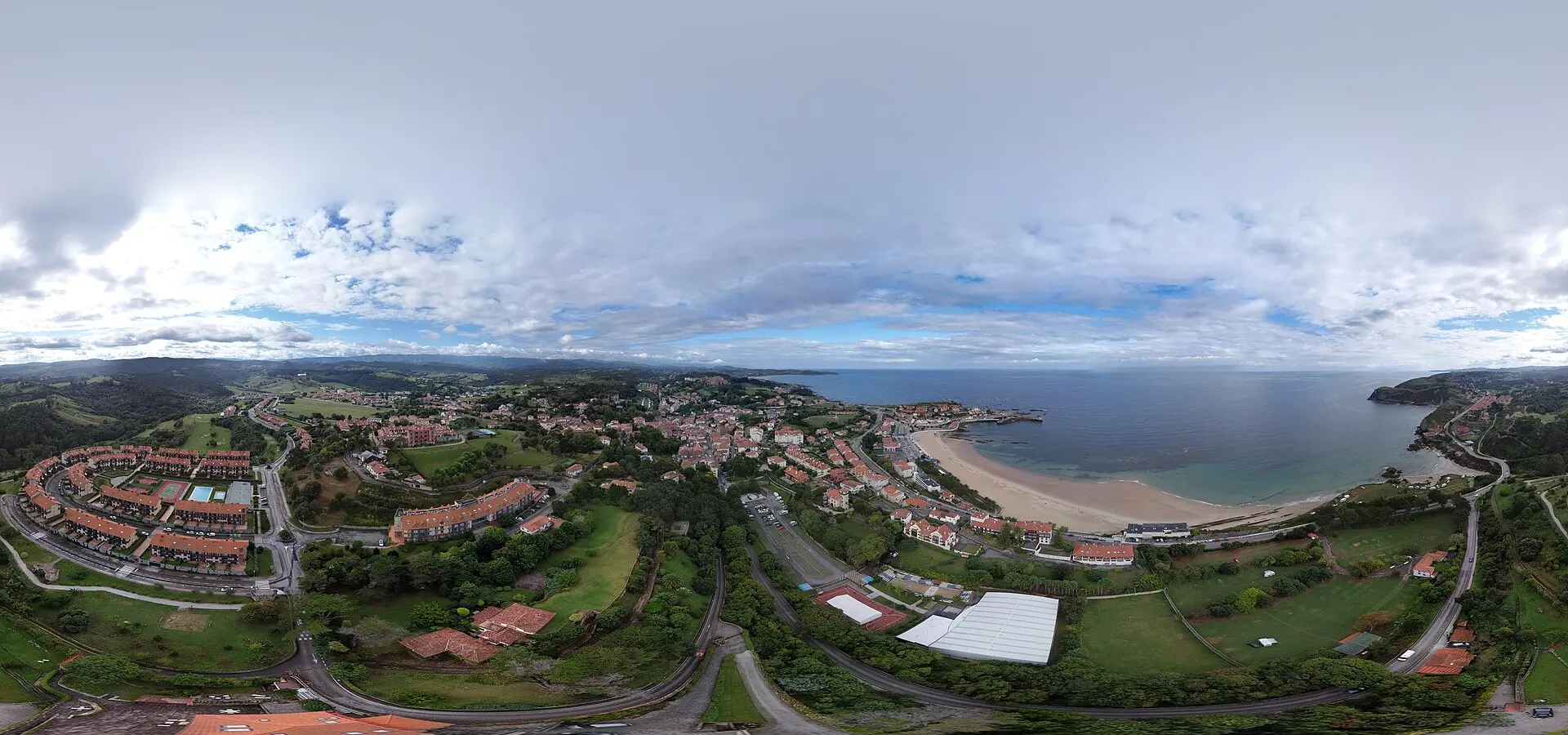
Costa Quebrada and Santander
Best Season
Frequent rain. Best from May to September.
Cantabria's Costa Quebrada, west of Santander, is one of the most distinctive geological landscapes on the Cantabrian coast. Liencres, Suances and Comillas combine sandy beaches, cliffs and architecture.
Highlights
- 1Liencres Dunes
- 2Santillana del Mar
- 3Gaudí’s whimsical creation in Comillas
- 4San Vicente de la Barquera, with the Picos in the background
About this route
The Costa Quebrada in Cantabria, to the west of Santander, is one of the most interesting geological formations on the European Atlantic coast and, paradoxically, one of the least well-known. Its descriptive name is not just a tourist marketing ploy: the coastline here is literally ‘broken’ by the differential erosion of rock layers of varying hardness, forming islets, natural arches, ‘urros’ (isolated crags) and the famous ‘Castros’ or pinnacles that rise from the sea like stony fingers. Geologists from all over Europe come to study this coastline because, within just a few kilometres, it offers an almost complete cross-section of the entire geological history of the Cantabrian Mesozoic.
The Liencres Dunes are one of the great surprises of the Cantabrian coast. They are the largest dune system in the north of the Iberian Peninsula — covering more than 200 hectares — and were formed by a curious combination of factors: the River Pas, as it flows into the sea here, deposits sandy sediments which the Atlantic wind blows inland, creating a miniature desert landscape that is completely unexpected in the heart of the verdant Cantabrian region. Riding across them on a motorbike along the narrow local road is like suddenly finding yourself on another continent: golden sand as far as the eye can see, and in the background the green peaks of the Cantabrian interior.
Santillana del Mar, a must-see stop on the route, is famous for a popular Spanish joke: it is said to be ‘the town of the three lies’ because it is neither holy, nor flat, nor does it have a sea. This is absolutely true, but the town is probably the best-preserved medieval settlement in the whole of Cantabria: perfectly intact cobbled streets, stone mansions with wooden balconies, medieval towers and a 12th-century Romanesque collegiate church, one of the most important in the north of the peninsula. Near Santillana lies the Altamira Cave, ‘the Sistine Chapel of Cave Art’, featuring Palaeolithic paintings dating back 14,000 years. The original cave is no longer open to visitors for conservation reasons, but the ‘neo-cave’ (an exact replica) is absolutely well worth a visit.
Comillas is the absolute highlight of the tour. During the 19th century, this small coastal village was home to one of Spain’s wealthiest dynasties, the López y López family, the Marquises of Comillas, who were ennobled by King Alfonso XII. Their patronage of the arts has left the town with an incredible architectural legacy: Gaudí’s Capricho (one of the Catalan architect’s earliest works outside Barcelona, dating from 1885, a small, utterly unique Modernist gem), the Palacio de Sobrellano (a monumental neo-Gothic building), the cliff-top cemetery with sculptures by Llimona, and the Pontifical University with features designed by Doménech i Montaner. Strolling through Comillas is like visiting an open-air Modernist museum.
For motorcyclists, the route is a relaxed ride (no major mountain passes, good road surfaces, moderate distances) but packed with points of interest. The logical end point is San Vicente de la Barquera, a fishing village with one of the most photogenic harbours on the Cantabrian coast, dominated by the silhouette of the Picos de Europa in the background. The best time to visit is from April to October. In summer, traffic increases significantly and the villages get very crowded; it’s best to visit on weekdays and early in the day. Fill up in Santander at the start and in Comillas halfway along the route. When it comes to dining, there’s no competition: Marisquería los Caracoles in Comillas, serving fresh seafood sold by weight at reasonable prices, or the Annua Restaurant in San Vicente de la Barquera (more expensive but with a Michelin star) if you’re looking for a top-class dining experience.
Route stops
Santillana del Mar
Monument
Medieval village with a Romanesque collegiate church.
Comillas
Monument
Village with Gaudí's El Capricho.
Practical information
Weather
Frequent rain. Best from May to September.
Traffic
Heavy traffic in summer.
Fuel stops
Frequent petrol stations all along the coast.
Where to stay on this route
The towns this route passes through — useful for splitting it into stages or sleeping near the start. Book ahead in high season.
- Santillana del MarSee places to stay
- ComillasSee places to stay
- SantanderSee places to stay
Affiliate links: if you book through them, Nomadiq earns a small commission at no extra cost to you.