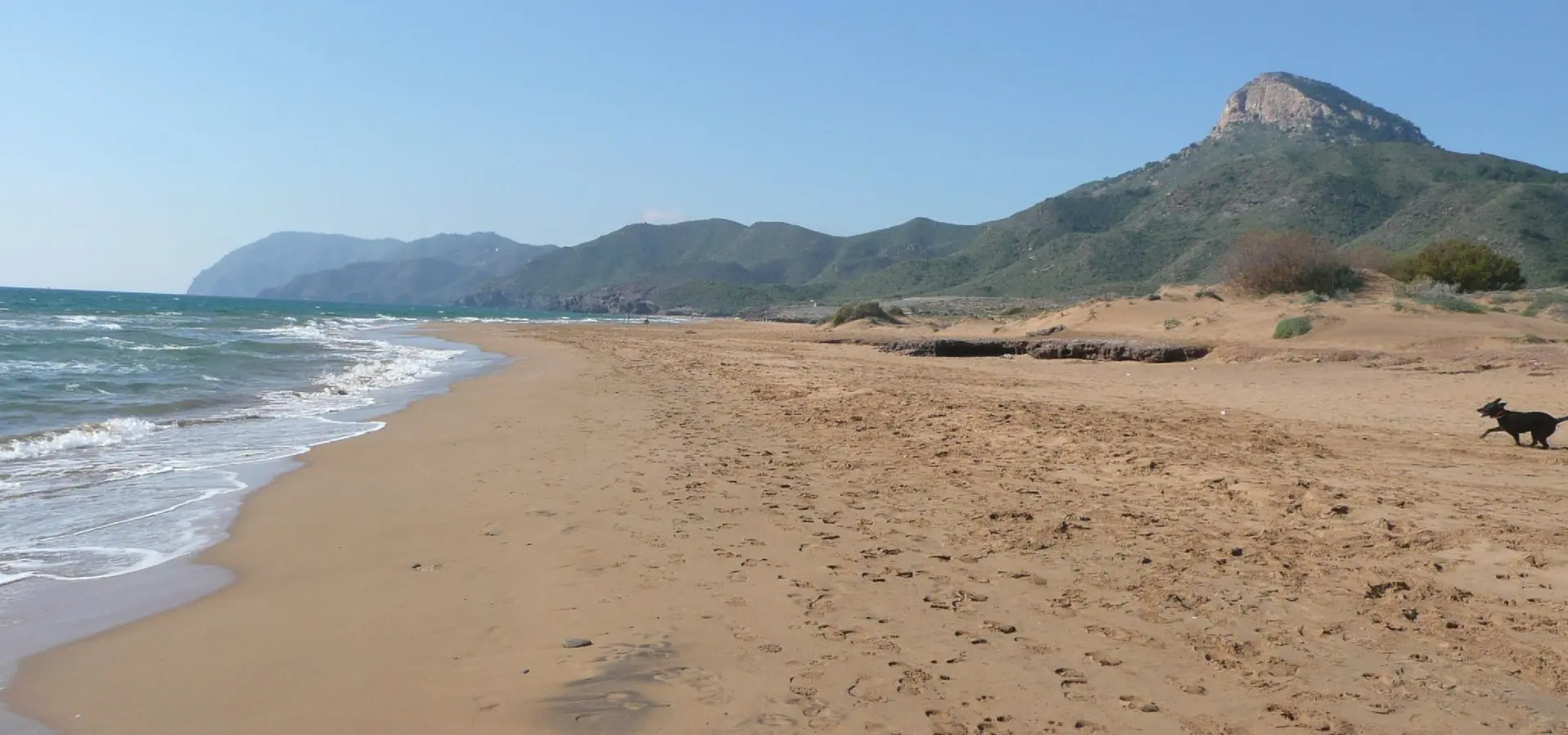
Calblanque and the coast of Cartagena
Best Season
Excellent all year round.
The Calblanque Regional Park, one of the most beautiful unspoilt coasts of the Spanish Mediterranean, combined with historic Roman Cartagena.
Highlights
- 1Calblanque Regional Park
- 2Roman Cartagena
- 3Cabo de Palos and the lighthouse
- 4La Manga del Mar Menor
About this route
The Calblanque, Monte de las Cenizas and Peña del Águila Regional Park is probably the last great haven of unspoilt coastline on Spain’s Mediterranean coast. In a region (Murcia) and along a stretch of coastline (between Cartagena and La Manga) so heavily urbanised and degraded by the tourism boom of the 1970s and 1980s, Calblanque survives as a miraculous exception: 19 km of completely unspoilt coastline, with golden sandy coves, shifting dunes, reddish cliffs, brackish lagoons, unique ecosystems and virtually no buildings. The reason for its survival is its designation as a protected area in 1992 (just in time, as urban development plans were already getting underway), and since then vehicle access has been controlled to prevent its degradation.
The beaches of Calblanque (Cala Magre, Playa Larga, Playa Negrete) are considered by many travellers to be the best in the whole of south-eastern Spain. The reason is geological: here, the deposits of golden sand reach right up to the water’s edge without the need for artificial retaining walls; the dunes grow freely inland, creating an intact dune system, and the Mediterranean Sea (relatively cold and churned up by the easterly wind) keeps the sand clean at all times. To access the beaches, vehicles must be parked in designated car parks on the edge of the park and visitors must walk 10–20 minutes along signposted paths; on a motorbike, you can get closer than by car, which is a small advantage for bikers.
Cartagena, the natural base for this route, is probably the most fascinating and underrated historic city on the entire Spanish Mediterranean coast. Founded by the Carthaginians in 227 BC as Qart Hadasht (‘New City’), it was one of the most important cities in the western Mediterranean during the 3rd century BC. Conquered by the Romans in 209 BC and renamed Cartago Nova, it became one of the most prosperous cities in the whole of Hispania, boasting an exceptional natural harbour, nearby silver mines and a strategic position between Italy and the Iberian Peninsula. The Roman Theatre of Cartagena, discovered by chance in 1988 during urban development works, is one of the most spectacular and best-preserved Roman theatres in the whole of Spain: seating 7,000 spectators, 32 metres high, with marble brought from Italy, and a 6th-century Christian chapel built on top of it, which demonstrates the archaeological complexity of Cartagena’s subsoil.
The Peral submarine, preserved in the port of Cartagena, deserves a special mention. It is the first electric-powered submarine in history, designed by the military engineer Isaac Peral between 1885 and 1888 and built at the shipyards in Cartagena itself. Its launch in 1888 was one of the most significant scientific events of the 19th century in Spain, but for political and bureaucratic reasons (the Spanish Admiralty, conservative and lacking in vision, regarded the submarine as ‘a technical whim’), the project was abandoned and Peral died frustrated and forgotten. Today, the submarine is on display in the harbour and is well worth a visit: it is an impressive example of 19th-century naval technology.
Motorcycling: the best times of year are spring and autumn; in summer it’s very hot and the beaches get very crowded. Stop for a refuel in Cartagena. For a bite to eat, in Cartagena, La Marquesita restaurant (in the Foro Romano neighbourhood) serves traditional Cartagena cuisine featuring seafood from Cartagena Bay at reasonable prices; the ‘caldero del Mar Menor’, the region’s signature dish (dry rice with mullet and ñora peppers), is a must-try. And a tip: combine your motorbike ride with at least a quick visit to the Roman Theatre (affordable admission) and the Peral submarine. The combination of unspoilt countryside, Roman history and 19th-century technology makes this route one of the most comprehensive and varied you can take in south-eastern Spain.
Route stops
Calblanque
Viewpoint
Regional Park with unspoilt coves.
Cabo de Palos
Viewpoint
Iconic lighthouse south of the Mar Menor.
Practical information
Weather
Excellent all year round.
Traffic
Moderate traffic in summer.
Fuel stops
Frequent petrol stations.
Where to stay on this route
The towns this route passes through — useful for splitting it into stages or sleeping near the start. Book ahead in high season.
- CartagenaSee places to stay
Affiliate links: if you book through them, Nomadiq earns a small commission at no extra cost to you.