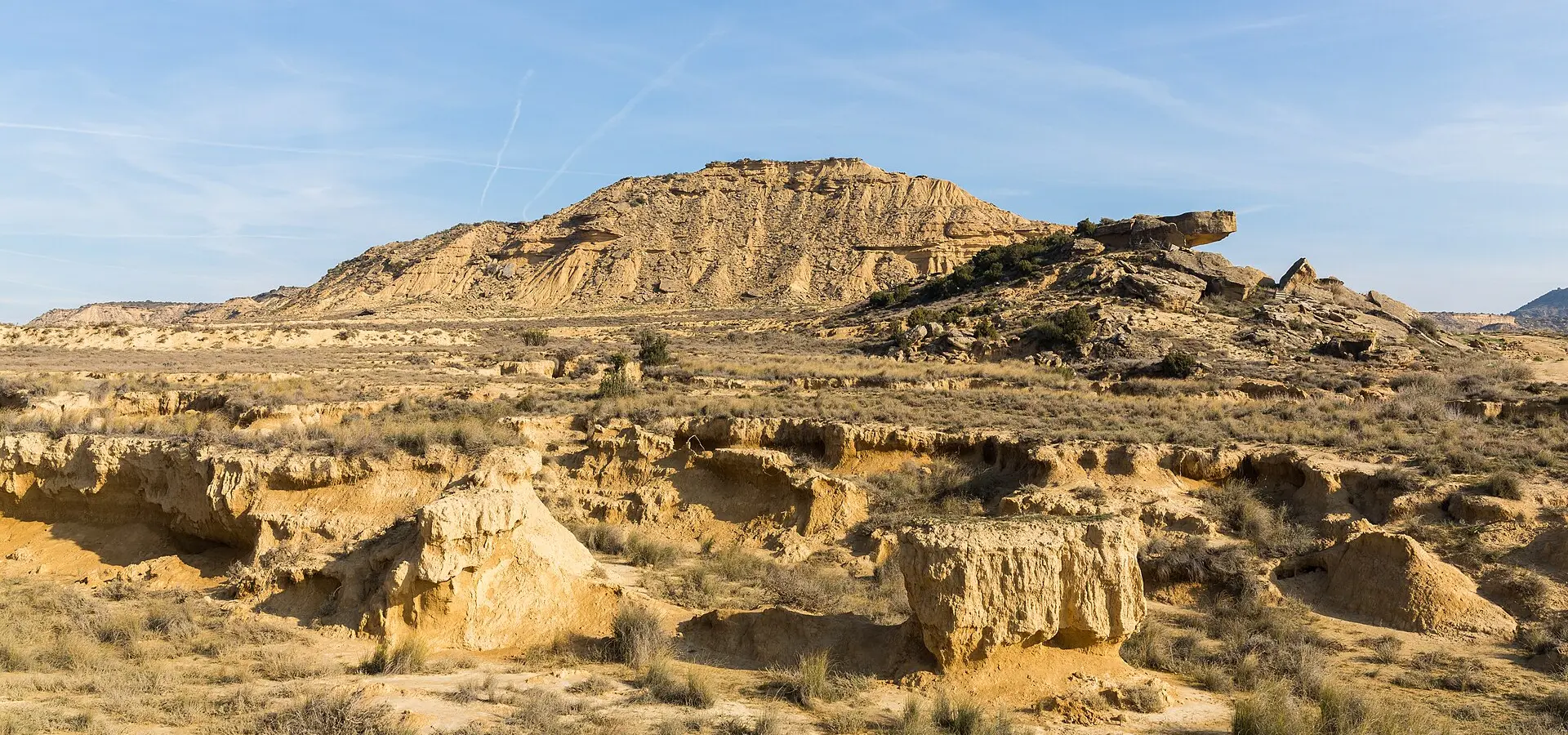
Bardenas Reales: semi-desert landscape
Best Season
Extreme heat in summer (+40°C). Best in spring and autumn.
The Bardenas Reales are a unique semi-desert landscape in Europe: gullies, plateaus and rock formations. A Biosphere Reserve with lonely tracks and roads.
Highlights
- 1Cabezo de Castildetierra
- 2Bardenas Biosphere Reserve
- 3A unique semi-desert landscape
- 4Trail running routes (optional)
About this route
The Bardenas Reales are one of the strangest yet most fascinating landscapes in the whole of Western Europe. In the south-east of Navarre, at the junction between the Ebro Valley and the Pre-Pyrenean range, lies an area of 42,500 hectares where geology, the semi-arid climate and erosion have created a landscape that is utterly unique on the continent: gullies, plateaus (cabezos), ravines, whimsical rock formations, steppe vegetation and, above all, an overall sense of being in a fragment of the American desert transported to northern Spain. When visitors arrive for the first time, the most common reaction is disbelief: no one expects to find anything like this right in the heart of the Pyrenees.
The geological history of the Bardenas is fascinating. Around 12 million years ago, this area was the bed of a tropical salt lake, and thick layers of gypsum, clay and soft sandstone accumulated, alternating with harder layers of limestone. When the region was subsequently uplifted by orogenesis and exposed to a dry continental climate (barely 350 mm of rainfall a year, comparable to some marginal areas of the Sahara), river and wind erosion began to wear away the soft layers faster than the hard ones, creating the whimsical pinnacles, mesas and gullies we see today. The process continues: the Bardenas are still visibly eroding, and famous formations such as the Cabezo de Castildetierra (the park’s visual icon) could disappear within another hundred years or so due to natural collapse.
The Cabezo de Castildetierra is probably the most photographed and iconic geological formation in the Bardenas Reales. It is a unique structure: a vertical wall of gypsum and clay topped by a ‘cap’ of hard limestone, formed by differential erosion between the two materials. The limestone protects the vertical gypsum column beneath, creating a formation reminiscent of a giant mushroom or, according to some, a natural cathedral. Its structural fragility is such that visitors must keep their distance: any significant vibration (including heavy vehicles passing nearby) could cause it to collapse. Seeing it at dawn or dusk, when the side light highlights its ochre and reddish colours, is one of the most cinematic visual experiences in the whole of northern Spain.
The Bardenas also play a very distinctive role in contemporary Spanish popular culture: they have been the setting for countless international films and TV series thanks to their cinematic resemblance to deserts and alien landscapes. Scenes were filmed here for Sergio Leone’s classic spaghetti western *The Good, the Bad and the Ugly* (1966), *Airbag* (1996), *El Cid* (1961), *Capitán Trueno* (2010), Bunbury’s music video for “El sueño imposible”, and, in particular, the fifth series of *Game of Thrones*, in which the Bardenas served as the “Dothraki Sea”. This cinematic fame has significantly boosted tourism over the last ten years, but the park retains its magic thanks to its vast expanse and the low visitor density relative to the available area.
Motorcycling tip: summer in the Bardenas is brutal (temperatures regularly exceed 40°C in July and August, with virtually no shade). The best times to visit are strictly spring (March–May) and autumn (October–November). Fill up in Tudela or Arguedas before entering the park; there are no facilities inside. The main tarmac road that crosses the park is accessible to any motorbike, but there are also secondary tracks (unpaved) for off-road motorbikes. For a bite to eat, in Arguedas, La Pastora Restaurant serves Navarran cuisine from the Ribera region, featuring local produce (Navarran lamb, asparagus, pochas). And a tip: visit the Bardenas at dawn if you can. The light of the early morning sun shining on the rocky outcrops and gullies is probably the best light of the year for photography, and what’s more, it’s not yet too hot to enjoy a ride on your motorbike.
Route stops
Cabezo de Castildetierra
Viewpoint
Iconic symbol of the Bardenas.
Arguedas
Village
Village with inhabited caves.
Practical information
Weather
Extreme heat in summer (+40°C). Best in spring and autumn.
Traffic
Very low traffic.
Fuel stops
Fuel stations in Tudela and Arguedas.
Where to stay on this route
The towns this route passes through — useful for splitting it into stages or sleeping near the start. Book ahead in high season.
- ArguedasSee places to stay
- TudelaSee places to stay
Affiliate links: if you book through them, Nomadiq earns a small commission at no extra cost to you.