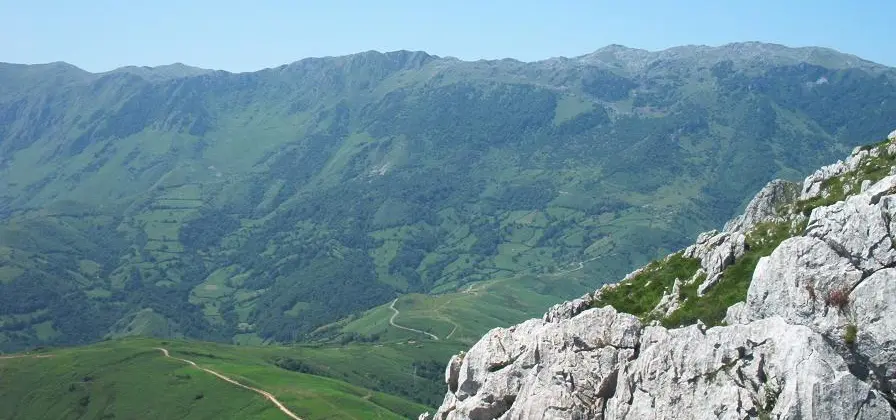
Puerto del Angliru: Spain's Steepest Wall
Best Season
Asturias: frequent rain. Summit fog common. Best May-October.
The Angliru, Spain's steepest paved climb (23.5% maximum gradient) and Vuelta a España legend. Asturian mountain pastures, summits in the clouds and the country's most extreme road.
Highlights
- 1Angliru: 23.5% gradient, the steepest road in Spain
- 2A legendary stage of the Vuelta a España
- 3Asturian brañas: red cows grazing among the clouds
- 4Mieres: capital of the October Revolution of 1934
About this route
The Puerto del Angliru is the steepest paved road in Spain and one of the steepest in all of Europe. Situated in the Sierra del Aramo, in the heart of Asturias, its final ramp at "La Cueña les Cabres" hits a 23.5% gradient — nearly a quarter of vertical rise per horizontal meter — an incline that professional cyclists at the Vuelta a España consider the limit of what is humanly possible on two wheels. On a motorcycle, the climb is a limit-pushing experience that tests both rider and machine: first gear, perfect balance, and gravity pulling you backward with a force you will not feel on any other road in Spain.
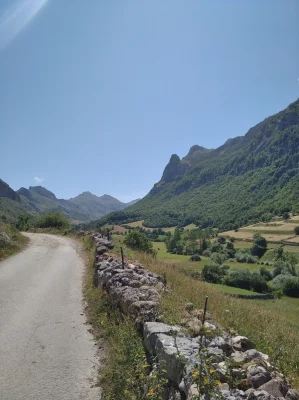
The Vuelta a España discovered the Angliru in 1999, and since then it has become one of the most mythical stages in world cycling. Alberto Contador, Valverde, Purito Rodríguez — the best riders in the Spanish peloton have suffered (and sometimes triumphed) on these impossible ramps. For the motorcyclist, the experience has an added dimension: the road passes through brañas (mountain meadows) where red Asturian cows graze freely, with peaks lost in the clouds and an endless green landscape that is the pure essence of the Cantabrian mountains.
The full route starts from Mieres del Camín, the mining town that served as the capital of the October Revolution of 1934, and climbs via the AS-231 to Riosa, where the actual ascent of the Angliru begins. The first kilometers are deceptively gentle (6–8%), but from kilometer 9 onward the gradient ramps up without mercy: Les Cabañes (15%), El Aviru (18%), El Gamonal (20%), and finally La Cueña les Cabres (23.5%) — a wall that must be attacked with determination and nerves of steel.
The surroundings of the Angliru include one of the most beautiful and least visited valleys in Asturias. Riosa and its hamlets still have centuries-old hórreos (wooden granaries raised on stone pillars, the most characteristic architectural element of Asturias), meadows of an impossible green, beech and chestnut forests, and a rural tranquility that contrasts with the extreme severity of the climb. The Desfiladero de Caranga, on the approach, adds a stretch of canyon with towering rock walls.
Rider practicalities: the Angliru is an extreme experience that demands a bike with strong low-end torque and tires in perfect condition. The 23.5% gradient is real and must be taken seriously. In rain, the road becomes dangerous. The descent also requires caution (make sure your brakes are well bled). For accommodation, Mieres offers affordable lodgings. For eating, fabada asturiana (available at any local restaurant), cachopo (a breaded steak stuffed with ham and cheese, an Asturian invention), and naturally poured sidra are absolute musts.
Route stops
Riosa
Village
Start of the Angliru ascent, centuries-old granaries.
Cumbre del Angliru (1.573 m)
map.stopType.puerto
Summit with 23.5% gradient, Vuelta cycling legend.
Desfiladero de Caranga
Viewpoint
Rocky canyon on the approach to Angliru.
Practical information
Weather
Asturias: frequent rain. Summit fog common. Best May-October.
Traffic
Very low traffic. Frequent cyclists. Narrow road.
Fuel stops
Petrol station in Mieres and Riosa. No petrol station on the climb.
Where to stay on this route
The towns this route passes through — useful for splitting it into stages or sleeping near the start. Book ahead in high season.
- RiosaSee places to stay
- Mieres del CamínSee places to stay
Affiliate links: if you book through them, Nomadiq earns a small commission at no extra cost to you.