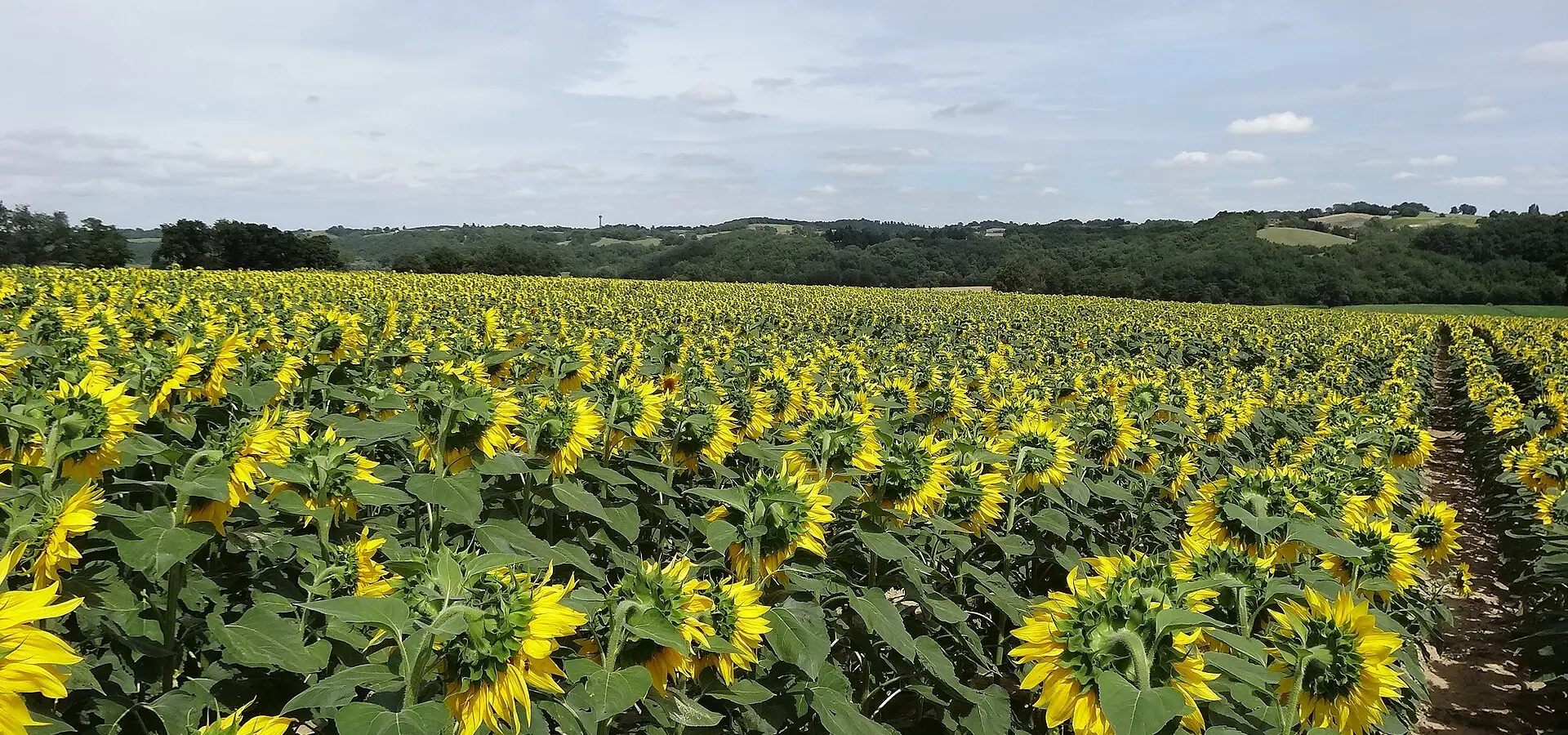
Gers: bastides, armagnac and sunflowers
Best Season
Temperate continental climate. Hot in summer, mild the rest of the year.
The Gers: the deepest and most unknown Gascony. Sunflower hills stretching to the horizon, medieval bastides, Armagnac distilleries and the emptiest roads in south-west France.
Highlights
- 1Sunflowers in July: yellow landscape stretching to the horizon
- 2Medieval bastides: Fourcès, Larressingle, Montréal
- 3Artisanal armagnac distilleries
- 4Empty roads through deepest Gascony
About this route
Gers is probably the least-known yet most charming département in all of southwestern France. Situated between Toulouse and Bordeaux, in the heart of historic Gascony, it is an endless succession of gentle hills blanketed with sunflowers (in July–August the entire landscape turns yellow), vineyards, wheat fields and small medieval villages left virtually untouched. The population density is laughably low for France — barely 30 inhabitants per km² — which means empty roads, peaceful villages and a feeling of rural solitude that is hard to find anywhere else in Western Europe.
The bastides of Gers are one of its greatest heritage treasures. These are fortified medieval towns from the 13th century, built by the kings of France and England during their struggle for control of Gascony, following a regular urban plan: a central arcaded square (the "place à couverts"), a grid of streets, ramparts and, typically, a fortified church. The finest bastides in Gers are Fourcès (the only circular bastide in all of France, with its perfectly round square), Larressingle (nicknamed the "Carcassonne of Gers", a tiny walled citadel completely intact) and Montréal-du-Gers (one of the earliest bastides, founded in 1255).
Armagnac is the other great cultural reason for the trip. It is the oldest brandy in France (predating cognac by over a century), distilled from local white wines in artisanal copper pot stills and aged for years in Gascon oak barrels. Unlike cognac (which is double-distilled), armagnac is distilled only once, giving it a rougher, fruitier, more "rustic" character. Visiting an artisanal distillery in Gers — Dartigalongue, Samalens, Janneau and Laberdolive are among the best known — and tasting armagnacs aged 10, 20 or 30 years is a sensory experience that rivals the finest cellars of Bordeaux or Rioja.
Gersoise gastronomy is, according to many critics, the finest rural cuisine in all of France. Foie gras was invented here (Gers disputes the honour with Périgord), the duck and goose confits are extraordinary, the Gersoise salads with magret and walnuts are celebrated, and the poulet gersois (free-range chicken raised in sunflower fields) is probably the best chicken in all of France. To crown the meal, an aged armagnac with Gascon apple tart.
Rider practicalities: Gers is entirely flat, with no technical difficulty. The departmental roads are narrow but well surfaced, and traffic is virtually non-existent. Season: April to October. Refuel in Auch (capital of Gers) or Condom. For lunch, the Hôtel des Trois Lys in Condom serves refined Gascon cuisine with local produce. And a tip: in July–August the sunflower fields are in full bloom and the landscape is mesmerisingly beautiful. Stopping every few kilometres to take photos is inevitable and irresistible.
Route stops
Fourcès
Village
The only circular bastide in France.
Larressingle
Monument
The "Carcassonne of the Gers", a walled citadel.
Condom
Village
Capital of Armagnac.
Practical information
Weather
Temperate continental climate. Hot in summer, mild the rest of the year.
Traffic
Almost no traffic. One of the emptiest areas in France.
Fuel stops
Petrol stations in Auch, Condom and Lectoure.
Where to stay on this route
The towns this route passes through — useful for splitting it into stages or sleeping near the start. Book ahead in high season.
- FourcèsSee places to stay
- LarressingleSee places to stay
- CondomSee places to stay
Affiliate links: if you book through them, Nomadiq earns a small commission at no extra cost to you.
Related routes
Canal du Midi: Toulouse to Béziers
Languedoc and Cathar Country
Col de Peyresourde and Bagnères-de-Luchon
French Pyrenees
Cirque de Gavarnie
French Pyrenees
Col du Tourmalet and Luz-Saint-Sauveur
French Pyrenees