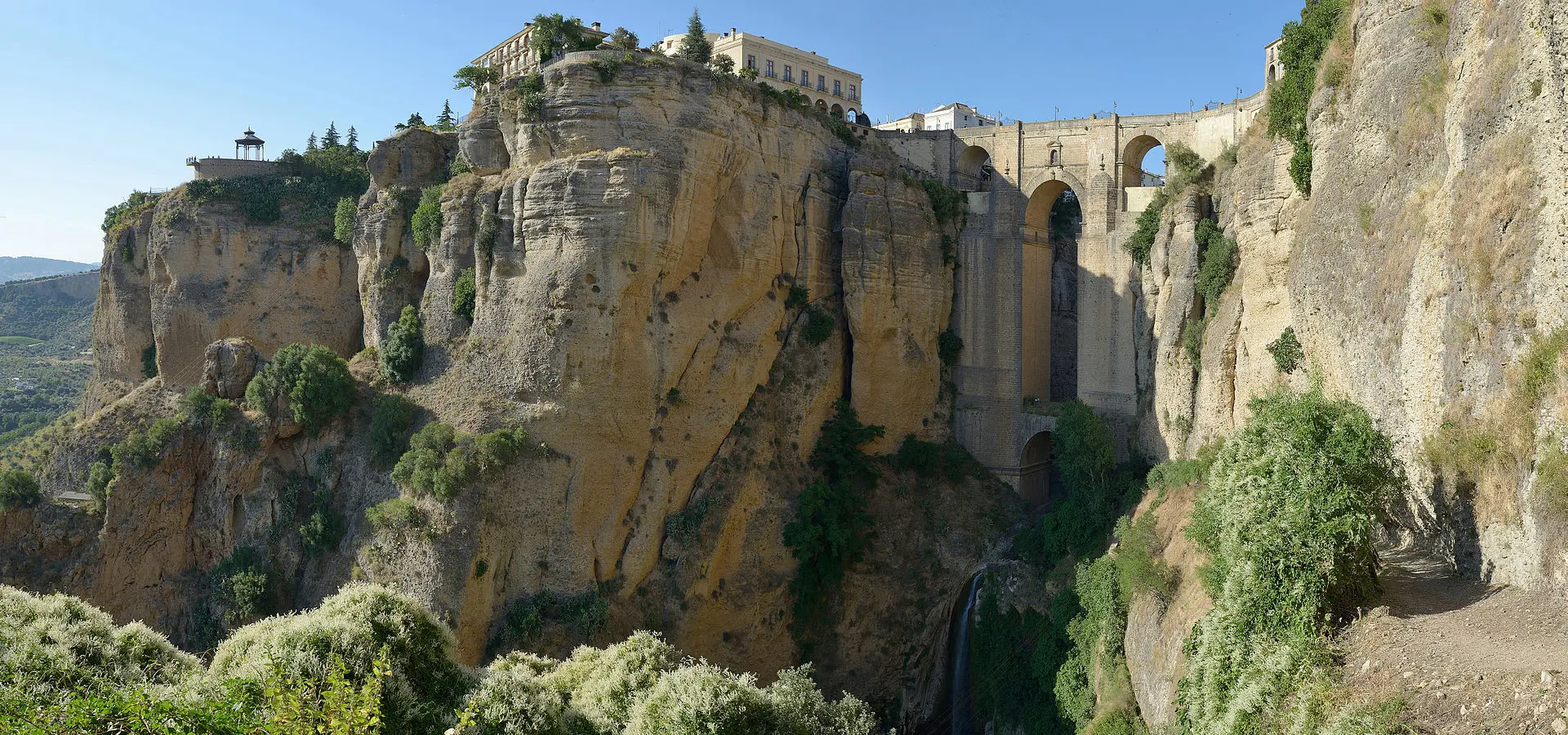
Ronda and the White Villages
Best Season
Good route almost all year round. Hot summer. Rain possible in winter.
The classic southern route: Ronda with its tajo, Setenil de las Bodegas, Zahara, Grazalema and spectacular roads through the Sierra de Grazalema, a Biosphere Reserve.
Highlights
- 1Ronda and the Tajo: an iconic city
- 2Setenil de las Bodegas: houses built under the rock
- 3Zahara de la Sierra and its reservoir
- 4Puerto de las Palomas (1,357 m)
About this route
Ronda is probably the first Spanish city that any traveller of the 19th-century Romantic movement visited for sheer aesthetic pleasure, even before the concept of tourism existed. Lord Byron, Théophile Gautier, Washington Irving and Rilke all passed through and wrote the same thing: that the Tajo de Ronda, the 100-metre-deep gorge that splits the city in two, is one of the most striking geological spectacles in Europe. When you cross the Puente Nuevo on your motorbike and glance down, you understand perfectly why Hemingway chose this city as the setting for "For Whom the Bell Tolls".
But the real reason to come to Ronda by motorbike is not Ronda itself — it is the roads that surround it. The A-374 towards Grazalema cuts through the Parque Natural Sierra de Grazalema, a limestone massif that holds the absolute rainfall record for the Iberian Peninsula: in 1963, over 4,300 mm of rain fell here in a single year — more than anywhere in Galicia. That abundance of water has sculpted an extraordinary karst landscape of sinkholes, caves, gorges and forests of pinsapo — an endemic fir of the southern peninsula that is practically a living fossil from the Tertiary period, a survivor of the ice ages.
The Pueblos Blancos route is not a modern tourist invention. When the Andalusians lost Granada and retreated into these mountains, the Catholic Monarchs repopulated the area with families from the north who were ordered to whitewash every house — partly for hygiene and partly for defence: a white village is visible from kilometres away and serves as a reference point from the coast for lookouts watching for Berber pirate raids. The chain of villages — Grazalema, Zahara, Setenil, Olvera, Ubrique — functioned as a network of optical towers, and even today, when you climb the Puerto de las Palomas, that visual logic becomes perfectly clear.
Setenil de las Bodegas deserves its own paragraph. The houses literally carved under massive rock overhangs are not an architectural whim or a postcard for tourists: they are the thermal solution that inhabitants found to the brutal Andalusian summer long before air conditioning existed. The heavy rock acts as a reverse radiator, keeping the houses at 18–20°C all year round. The bodegas that give the village its name took advantage of precisely that thermal stability to age wines, which in the 15th century travelled by donkey to Cádiz to be shipped to the Caribbean. Today the "bodegas" sell tapas and cold beer, and the effect is no less spectacular.
For the rider, the classic loop links Ronda to Grazalema, climbs the Puerto del Boyar (1,103 m), drops down to Zahara, takes the Puerto de las Palomas and returns via Setenil. Excellent tarmac, continuous curves, scenery at every bend and very little traffic except in August. A tip: Mesón el Tajo in Ronda, tucked away in a lane in the old town, serves an oxtail stew that justifies a long stop. And if you come in February, the ride up to Grazalema through almond trees in bloom is one of the most beautiful experiences you can have on two wheels in southern Spain.
Route stops
Grazalema
Village
Capital of the Sierra de Grazalema.
Zahara de la Sierra
Village
White village under a Moorish castle.
Setenil de las Bodegas
Village
Village with houses under rock walls.
Practical information
Weather
Good route almost all year round. Hot summer. Rain possible in winter.
Traffic
Moderate traffic in Ronda. Quiet roads.
Fuel stops
Petrol stations in Ronda, Grazalema and Setenil.
Where to stay on this route
The towns this route passes through — useful for splitting it into stages or sleeping near the start. Book ahead in high season.
- GrazalemaSee places to stay
- Zahara de la SierraSee places to stay
- Setenil de las BodegasSee places to stay
Affiliate links: if you book through them, Nomadiq earns a small commission at no extra cost to you.
Related routes

Caminito del Rey, El Chorro and Antequera
Andalusia
Axarquía: Comares, Frigiliana and Málaga's Mudéjar Route
Andalusia
Córdoba's Subbética: Zuheros and Priego
Andalusia
Rif: Chefchaouen and the route of the blue mountains
Morocco