Volcanic Garrotxa: Olot and Santa Pau
Best Season
Excellent all year round. Spectacular in autumn with beech trees in colour.
The volcanic area of La Garrotxa offers unique landscapes with extinct volcanic cones, beech forests and medieval villages. Olot, Santa Pau and the Fageda d'en Jordà in a quiet but intense route.
Highlights
- 1Parc Natural Zona Volcànica de la Garrotxa
- 2Fageda d'en Jordà: a beech forest growing on lava
- 3Santa Pau: a perfectly intact medieval village
- 4Castellfollit de la Roca and Besalú
About this route
The Garrotxa is the only volcanic zone in all of Catalunya and one of the most geologically fascinating in the western Mediterranean. Its 40 extinct volcanic cones — the most recent erupted barely 11,500 years ago — and its extensive basaltic lava flows have created an utterly unique landscape: cultivated fields on black volcanic soils, beech forests growing on ancient lava, rivers cutting through basalt gorges and medieval villages perched literally on top of craters. It is one of those places where the geography is so strange it looks like another planet, and yet it is barely an hour's ride from Girona and two from Barcelona.
The Fageda d'en Jordà is probably the most magical corner of the park and one of the most singular beech forests in Europe. Its singularity lies in a rare geological circumstance: the forest grows directly on a relatively recent basaltic lava flow (from the Croscat volcano, around 17,000 years ago), and beech trees usually need deep, moist soils that simply do not exist here. But the beeches have adapted to the volcanic substrate in extraordinary fashion, forming a dense forest where the light filters through in special shades of green and the silence is total. It is one of those places that justify a trip in themselves. Visiting the Fageda requires walking its trails — by motorcycle you can only reach the Can Serra car park — but the basic 30-minute stroll is absolutely worth it.
Santa Pau, the park's emblematic village, is probably the best-preserved medieval ensemble in all of inland Catalunya. Its arcaded Plaça Major, its narrow alleyways, its houses of dark volcanic stone and its small 13th-century castle form a harmonious urban whole that has remained virtually intact since the 16th century. What makes it most special is that Santa Pau is not a museum village: people live here, the houses are inhabited, there are a couple of authentic restaurants and a family bakery that has been operating for four generations. Walking its streets first thing in the morning, before the tourists arrive, is an almost mystical atmospheric experience.
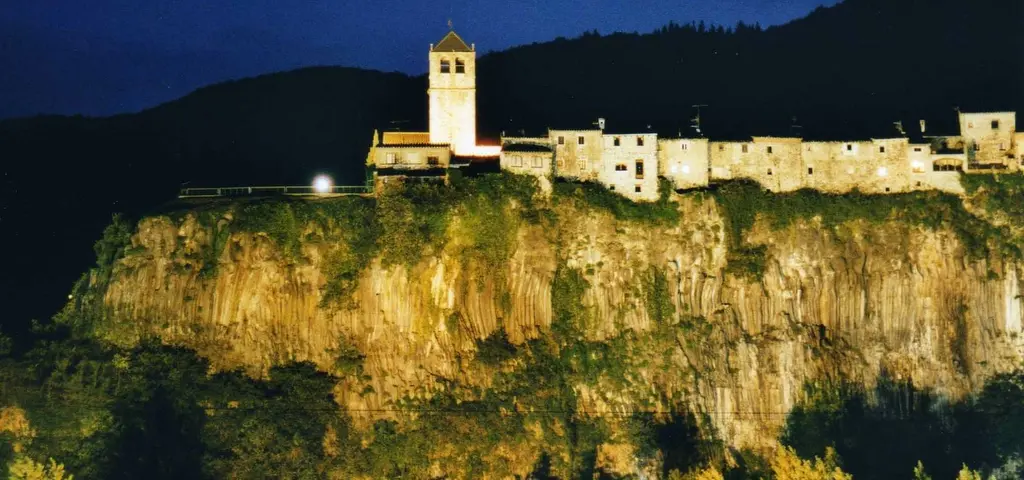
Castellfollit de la Roca, another extraordinary village in the park, is literally perched on a vertical basalt cliff 50 metres high. The geological reason is fascinating: the river Fluvià carved a gorge through an ancient lava flow over thousands of years, leaving a perfect vertical basalt wall on which the medieval inhabitants decided to build their village. The houses sit at the very edge of the precipice, with balconies jutting out over the void, and from the opposite side of the valley (where there is a viewpoint) the sheer oddness of the place becomes clear. Castellfollit has been photographed more times than any other village in Catalunya, but seeing it in person remains striking.
The natural circuit closes at Besalú, just outside the park but barely 15 km to the east. Besalú is one of the most complete medieval towns in northern Spain: it has a fortified 12th-century Romanesque bridge (the town's visual icon), an intact historic centre with arcaded squares, Romanesque churches, a former synagogue, 12th-century Jewish ritual baths (the only ones preserved in all of Spain and possibly the best preserved in Europe) and an utterly enveloping medieval atmosphere. For the rider, this route combines the best of inland Catalunya: unique geography, intact medieval architecture, honest gastronomy (the Fageda produces some of Spain's finest yoghurts, Yogures de la Fageda, sold across Europe) and near-empty secondary roads. The perfect season is spring and autumn, especially October when the volcanic beech forests turn golden. For dining, Cal Sastre in Santa Pau has been an institution since 1929: traditional Garrotxa cooking with locally sourced produce.
Route stops
Fageda d'en Jordà
Viewpoint
Beech forest on lava flows.
Santa Pau
Village
Medieval village in the middle of a volcanic park.
Castellfollit de la Roca
Viewpoint
Village on a 50 m basaltic cliff.
Besalú
Monument
Medieval village with Romanesque bridge.
Practical information
Weather
Excellent all year round. Spectacular in autumn with beech trees in colour.
Traffic
Moderate traffic. More tourism in autumn and weekends.
Fuel stops
Petrol stations in Olot and Besalú.
Where to stay on this route
The towns this route passes through — useful for splitting it into stages or sleeping near the start. Book ahead in high season.
- Santa PauSee places to stay
- BesalúSee places to stay
- OlotSee places to stay
Affiliate links: if you book through them, Nomadiq earns a small commission at no extra cost to you.