Évora and Inland Alentejo
Best Season
Extreme heat in summer (40°C+). Best spring and autumn.
Évora (UNESCO) with its Roman temple and Chapel of Bones, and inland Alentejo: cork oak hills, white villages, megaliths and Portugal's emptiest roads.
Highlights
- 1Évora (UNESCO): Roman temple and Chapel of Bones
- 2Cromeleque dos Almendres: largest cromlech on the Iberian Peninsula
- 3Montado: cork oak woodlands
- 4Portugal's N2: the Route 66 of the Alentejo
About this route
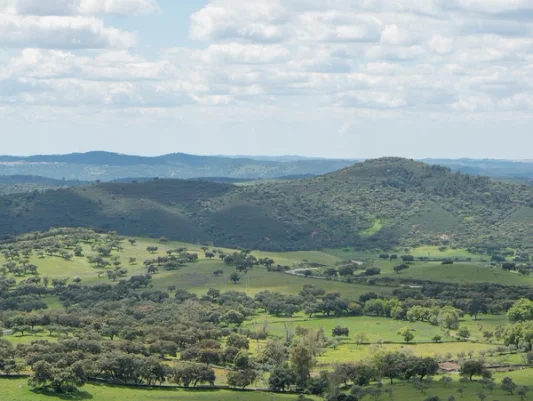
The inland Alentejo is Portugal's Castile: a rolling, dry plateau, scorching in summer, covered in montados (cork oak woodlands identical to the Spanish dehesas), with whitewashed villages separated by miles of lonely countryside and a feeling of vastness and emptiness more reminiscent of deep Andalusia than the green, wet image many people associate with Portugal. For Spanish riders, it is a strangely familiar landscape but with distinct nuances: the villages are whiter, the architecture more austere, the cork oaks more monumental, and the solitude more complete.
Évora is the capital of the Alentejo and one of the most fascinating cities in all of Portugal. Its historic centre, a UNESCO World Heritage Site, packs 2,000 years of history into a few hundred metres: the Temple of Diana (one of the best-preserved Roman temples on the entire Iberian Peninsula, dating to the 1st century AD), the Cathedral (Romanesque-Gothic, 12th century, with a cloister and views from the tower), the University (the second oldest in Portugal, founded in 1559 by the Jesuits), and the famous Capela dos Ossos (Chapel of Bones), a 16th-century chapel whose walls and columns are entirely lined with human bones and skulls, with an inscription at the entrance that reads: "Nós ossos que aqui estamos, pelos vossos esperamos" ("We bones that lie here await yours").
The megalithic landscape of the Alentejo is another major draw. Portugal boasts one of the highest concentrations of megalithic monuments in all of Europe, and the Évora area is especially rich: the Cromeleque dos Almendres (the largest cromlech on the Iberian Peninsula, with 95 monoliths arranged in concentric circles, dated to around 5000 BC) and the Anta Grande do Zambujeiro (the largest dolmen on the entire peninsula, with an 8-metre-tall chamber) are the two most impressive examples.
The roads of the inland Alentejo are the emptiest in all of Portugal and quite possibly in all of Western Europe. The N2 (Portugal's answer to Route 66) runs through the Alentejo from north to south for over 200 km with virtually no traffic — long straights between cork oaks, gentle climbs over rolling hills, and whitewashed villages where life seems to unfold in slow motion.
Practical tips for riders: the Alentejo gets extremely hot in summer (40 C+ is common); spring and autumn are best. The roads are easy (no mountain passes, good tarmac) but distances can be deceptive due to the monotony of the landscape. For accommodation, the Pousada dos Lóios in Évora (a 15th-century convent converted into a hotel) is an architectural experience in itself. For dining, the Alentejo has the finest rustic cuisine in Portugal: migas com carne de porco preto (breadcrumbs with Alentejo black pork), açorda de bacalhau (a thick salt-cod and bread soup), and the famous porco preto alentejano (Iberian pork raised in the montado).
Route stops
Évora
Monument
Roman temple, cathedral and Chapel of Bones.
Cromeleque dos Almendres
Monument
Largest cromlech on the Iberian Peninsula (5000 BC).
Estremoz
Village
White town with castle and marble market.
Practical information
Weather
Extreme heat in summer (40°C+). Best spring and autumn.
Traffic
Almost zero traffic. Empty roads.
Fuel stops
Petrol stations in Évora, Estremoz and Beja.
Where to stay on this route
The towns this route passes through — useful for splitting it into stages or sleeping near the start. Book ahead in high season.
- ÉvoraSee places to stay
- Cromeleque dos AlmendresSee places to stay
- EstremozSee places to stay
Affiliate links: if you book through them, Nomadiq earns a small commission at no extra cost to you.