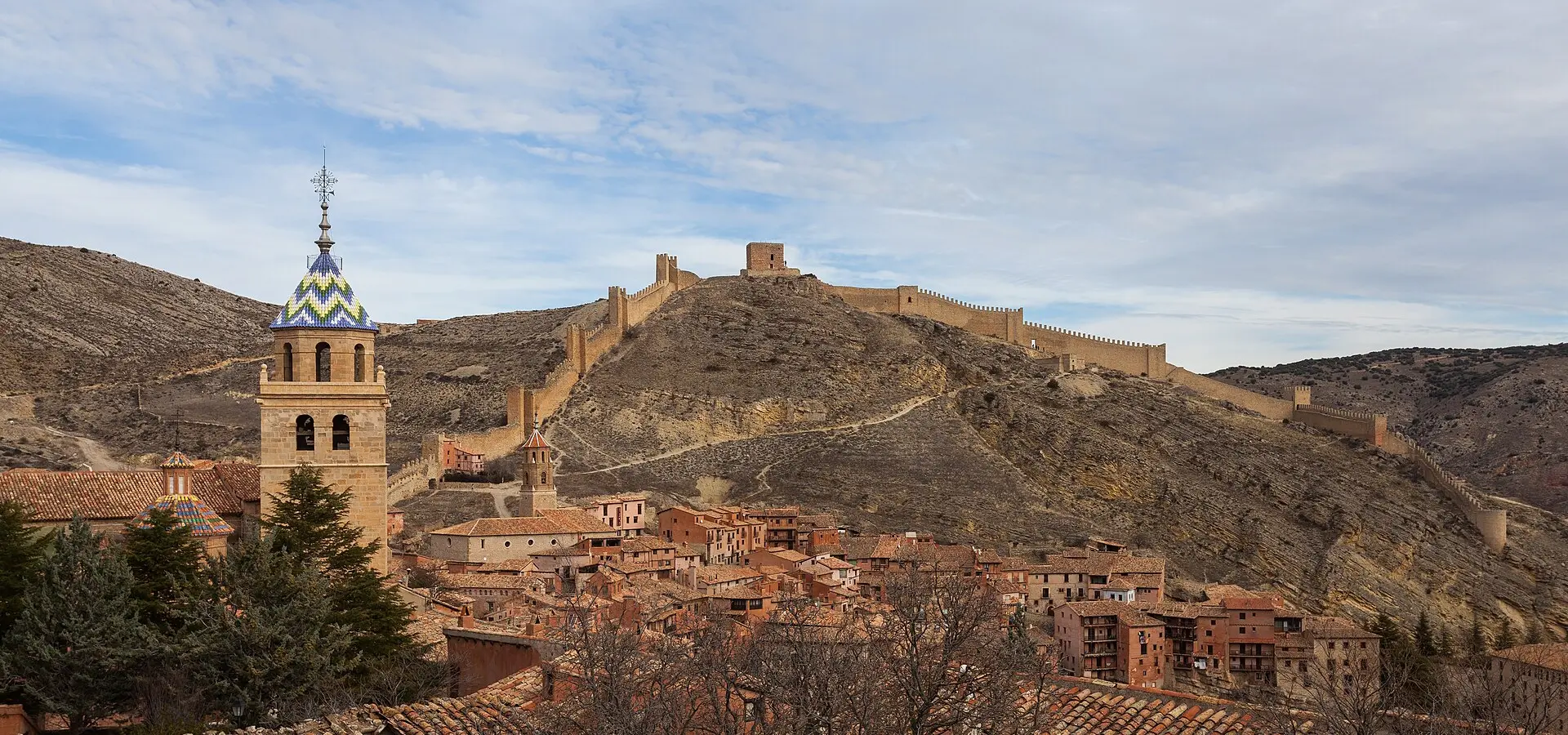
Albarracín and Sierra de Albarracín
Best Season
High mountain area: frequent snow from November to April. Cool and pleasant summer, ideal when the coastline is tight. Beware of afternoon thunderstorms in July-August.
Circular route through the Sierra de Albarracín based in one of the most beautiful villages in Spain. Empty roads at more than 1,500 m, endless pine forests and almost alpine landscapes.
Highlights
- 1Albarracín: one of the most beautiful towns in Spain
- 2Pine forests of the Sierra de Albarracín above 1,500 m
- 3A-1512: wide sweeping curves with zero traffic
- 4Source of the river Tajo (optional detour)
About this route
Albarracín is probably the most photographed town in Teruel and, along with Cuenca, the only "hanging city" in Spain with a historic quarter so completely intact it looks like a film set. Its distinctive reddish colour — houses painted with plaster tinted by local iron oxide — gives it an almost North African atmosphere, and that is no coincidence: during the 10th and 11th centuries, Albarracín was the capital of a small independent taifa kingdom, ruled by the Berber dynasty of Banu-Razin (hence the town's current name), which thrived by trading with León, Castilla and Valencia from its strategic position high above a meander of the Guadalaviar river.
What nobody tells you is that Albarracín was also, throughout the 12th century, a virtually independent "republic," neither Christian nor Muslim, governed by a Navarrese lineage (the Azagra family) who proclaimed themselves "vassals of the Virgin Mary" so they would not have to answer to the King of Aragón, the King of Castilla, or the Pope. That peculiar autonomy left behind a unique urban layout and architecture: Albarracín's historic quarter resembles no other Aragonese town because it was never planned by a crown or a church, but grew organically following the whims of the terrain. Hence those impossible streets, those overhanging upper floors, those arches spanning the alleyways, and that feeling of an intact medieval labyrinth.
For the motorcyclist, however, what is truly interesting about the area is the Sierra de Albarracín surrounding the town. It is an unusual mountain range: part of the Iberian Cordillera, with an average altitude of 1,500 m, covered by one of the most extensive and best-preserved pine forests in Spain, and above all virtually uninhabited (the population density of the district is less than 4 inhabitants per km², comparable to Lapland). The roads that cross it — the A-1512 towards Bronchales, the A-1704 towards Frías de Albarracín, the TE-V-9031 towards Royuela — are secondary roads that are almost empty, with generally good tarmac, wide sweeping curves, and perfect for linking throttle rolls without any surprises.
A hidden treasure of the area, barely twenty kilometres from Albarracín, is the source of the river Tajo. Yes: the Tajo, the river that defines central Iberia and flows through Toledo and Lisbon, is born here, on a meadow of the Muela de San Juan at 1,593 m altitude, in an utterly solitary spot marked by a simple stone monument. It is one of those places where geography feels like something physical and thrilling. Another essential stop is Orihuela del Tremedal, a highland town at 1,450 m with a surprising Baroque sanctuary and one of the finest collections of shepherd's huts converted into rural lodgings in all of Spain.
In practical terms, the Sierra de Albarracín is ideal in summer — cool, breezy, pleasant when the rest of Aragón is scorching — and harsh in winter, with frequent snowfall from November to March and frosts that can reach -15°C. The golden motorcycling season runs from May to October. A food tip: in Albarracín town, avoid the restaurants on the main square (expensive and touristy) and head up to Mesón del Gallo, on a narrow lane in the old quarter, where they serve river trout caught in the Guadalaviar and traditional shepherd's migas with grapes just like grandparents used to make. Fill up your tank in Teruel before heading up: inside the sierra there are only two petrol stations, one in Bronchales and another in Royuela.
Route stops
Bronchales
Village
A mountain village at 1,560 m, the nerve centre of the sierra.
Orihuela del Tremedal
Village
High mountain village with a baroque sanctuary.
Frías de Albarracín
Village
A village near the source of the Tagus.
Practical information
Weather
High mountain area: frequent snow from November to April. Cool and pleasant summer, ideal when the coastline is tight. Beware of afternoon thunderstorms in July-August.
Traffic
Virtually no traffic. Some cyclists in summer.
Fuel stops
Refuel in Teruel or Cella before going up. Petrol station in Bronchales.
Where to stay on this route
The towns this route passes through — useful for splitting it into stages or sleeping near the start. Book ahead in high season.
- BronchalesSee places to stay
- Orihuela del TremedalSee places to stay
- Frías de AlbarracínSee places to stay
Affiliate links: if you book through them, Nomadiq earns a small commission at no extra cost to you.
Related routes
Route of Silence: Empty Spain in Teruel
Aragon
Teruel's Maestrazgo: Cantavieja and La Iglesuela
Aragon
Sierra de Gúdar and Valdelinares
Aragon
Serranía de Cuenca: Ciudad Encantada and the Source of the Cuervo
Castilla-La Mancha